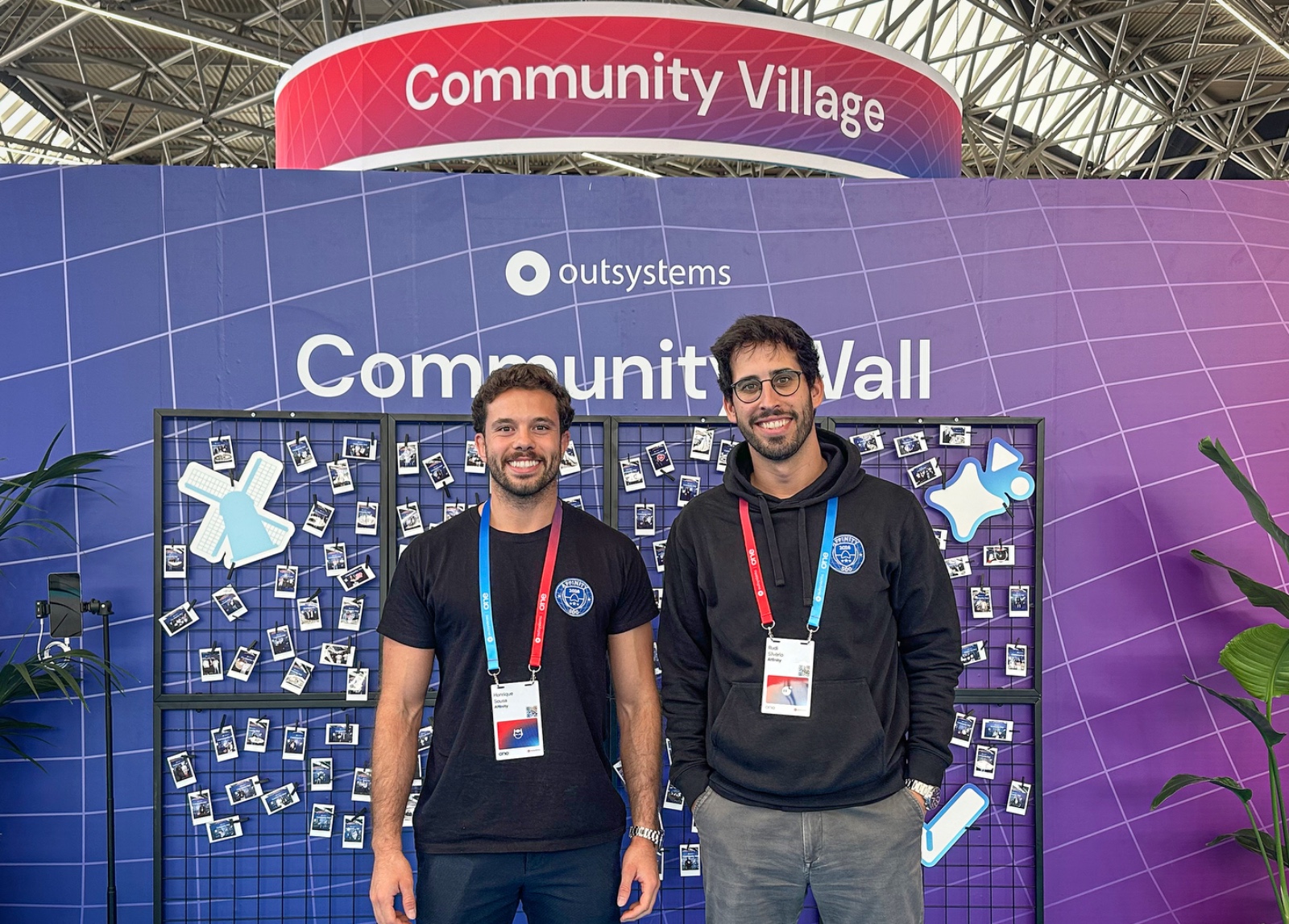
What Affinity Players brought back from ONE Conference 2026
After two days at ONE Conference 2026 in Amsterdam, one message stood above all others: the future of Artificial Intelligence isn’t just about moving faster. It’s about staying in control while moving faster.
Representing Affinity at the event, Rudi Silvério and Henrique Sousa returned with a clear mission: to understand what the latest OutSystems announcements truly mean for organizations preparing for the next generation of digital transformation.
To do that, they sat down with two Affinity Players who experienced the conference from different perspectives: Ricardo Marques, Architect, and Ana Bandarra, OutSystems Champion.
Their insights revealed a common theme: the future belongs to organizations that can combine intelligence, governance, and human expertise.
“This isn’t a new feature. It’s a new architectural paradigm.”
When asked which announcement could have the biggest impact on clients’ projects, Ricardo Marques didn’t hesitate.
The Open Agentic Systems Platform fundamentally redefines the enterprise landscape. We’re moving from user-driven applications to architectures capable of orchestrating autonomous systems.
For Ricardo, the most significant shift isn’t the technology itself, but the architectural mindset behind it.
Solutions such as the Enterprise Context Graph and OutSystems Mentor demonstrate how the platform is evolving to support intelligent systems while preserving structure, scalability, and architectural integrity.
His conclusion is straightforward:
The platform is being designed so intelligence can operate safely inside the enterprise.
The conversation everyone was having: Governance
Artificial Intelligence dominated the agenda. Governance dominated the conversations.
Reflecting on what will most influence how organizations adopt Agentic AI, Ricardo repeatedly returned to the same concept: guardrails.
AI systems need governance frameworks that ensure security, predictability, and control. Innovation without governance creates risk.
He also highlighted the importance of building architectures that remain independent from specific AI providers, allowing organizations to evolve without becoming locked into a single technology.
The message is clear: the organizations that will succeed won’t necessarily be the first to adopt AI. They’ll be the first to govern it effectively.
“The future still belongs to people.”
While Ricardo brought the architectural perspective, Ana Bandarra offered a different lens.
When asked to summarize her ONE Conference experience in a few words, her answer was immediate:
Inspiring, challenging, and energizing.
For Ana, the conference confirmed that low-code is entering a new phase, deeply connected to Agentic AI, automation, and accelerated development.
Yet perhaps her most important insight had little to do with technology itself.
It’s no longer enough to master the technology. You need to understand the business, the client’s context, and the real problem you’re trying to solve.
As AI removes repetitive tasks, professionals will have more room to focus on what truly creates value: architecture, user experience, accessibility, quality, business impact, and strategic thinking.
And there is one skill that will become even more valuable. Communication.
The best solutions are born when we can translate real needs into technology that creates impact.
For that reason, Ana believes the most valuable professionals of the next decade won’t simply be those who master the most tools. They will be the ones who best understand people, business, and context.
What Affinity takes from this conference
Although they experienced the conference from different angles, Ricardo and Ana arrived at the same conclusion.
Technology is evolving faster than ever. AI is transforming how we design, build, and operate digital solutions. But long-term success will depend on something deeper than technology alone: governance, business understanding, communication, and human expertise.
As Ana puts it:
The future of OutSystems is no longer only about accelerating development. It’s about accelerating impact.
And perhaps that was the biggest lesson from Amsterdam. The organizations that will lead the AI era won’t simply be those that adopt new technologies first. They will be the ones capable of combining innovation with governance, intelligence with responsibility, and speed with purpose.
In your view, what will be the biggest challenge of the Agentic AI era: technology, governance, or people? Let’s continue the conversation.
#ONEConference #OutSystems #ArtificialIntelligence #AgenticAI #LowCode #DigitalTransformation #TechnologyLeadership #AffinityPortugal
